Railway Repair in Permafrost: Reconnecting a Northern Community
In northern Manitoba, the town of Churchill serves as Canada’s only Arctic deep-water port connected to the national rail network. Located approximately 250 km from the nearest community and accessible primarily by rail or air, Churchill relies heavily on transportation infrastructure for the movement of people, goods, fuel, and essential services.
When severe flooding damaged portions of the Hudson Bay Rail Line in the spring of 2017, the impacts extended far beyond the railway itself. More than 1,000 residents of Churchill, along with dozens of nearby northern and First Nations communities, experienced significant disruptions to their supply chains and transportation access.
Restoring the railway quickly, safely, and cost-effectively became a priority.
What happened to the Hudson Bay Rail Line?
Following unusually heavy flooding, approximately 30 sections of the rail corridor sustained damage. Washouts, erosion, and subgrade instability affected nearly two kilometres of railway infrastructure, making portions of the line unsafe for operation.
The damage highlighted several common challenges faced by northern transportation corridors:
- Flood-related erosion of rail embankments
- Soft and unstable subgrade conditions
- Permafrost degradation
- Remote access constraints
- Limited construction windows due to seasonal conditions
With the railway out of service, communities that relied on the line were forced to depend on costly alternative transportation methods, including air transport for critical supplies.

Why Railway Repairs Are Difficult in Northern Environments
Railway infrastructure is designed to support repeated dynamic loading from heavy rail traffic. In northern regions, these engineering demands become even more complex due to environmental conditions.
- Permafrost and Freeze-Thaw Cycles
When permafrost thaws, the ground beneath the rail structure can lose strength and settle unevenly. This differential settlement can lead to track instability, increased maintenance requirements, and reduced service life. - Soft and Weak Subgrades
Northern soils often consist of muskeg, organic deposits, or saturated materials with limited bearing capacity. Without reinforcement, these soils can contribute to excessive settlement and ballast degradation. - Erosion and Flood Damage
High water events can wash away embankment materials, weaken foundations, and accelerate long-term infrastructure deterioration if not properly addressed. - Remote Construction Logistics
Mobilizing equipment, personnel, and materials to remote locations significantly increases project costs and can create tight construction schedules, especially when transportation access is limited.
Key Engineering Challenges on the Churchill Rail Restoration Project
| Challenge | Project Impact |
| Remote location | Transportation of crews and materials required careful planning |
| Permafrost conditions | Ground stability concerns required specialized design considerations |
| Flood-damaged embankments | Rail foundations needed rehabilitation and reinforcement |
| Linear construction access | Repairs had to be completed sequentially to enable access to subsequent repair locations |
| Compressed timeline | Communities required restoration of service as quickly as possible |

Evaluating Stabilization Options for Rail Infrastructure
Traditional rail rehabilitation methods often rely on extensive excavation and replacement of poor soils with higher-quality imported aggregate. While effective in some applications, these approaches can become prohibitively expensive in remote regions where transportation costs are significant.
Ground stabilization systems such as geocells offer an alternative approach by improving the performance of available aggregate and distributing loads more efficiently through the underlying subgrade.
For remote projects, geocell systems can provide several advantages:
- Reduced aggregate requirements
- Improved load distribution
- Enhanced resistance to lateral movement
- Faster installation
- Reduced transportation and mobilization costs
- Lower environmental disturbance

How Tough Cell® Was Used on the Project
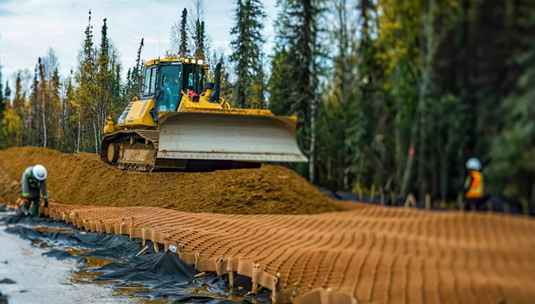
Together with our engineering partner, Stratum Logics, Paradox Access Solutions utilized Tough Cell® NPA geocell technology to stabilize the damaged sections of the rail corridor.
Tough Cell® is a high-strength geocell system designed to confine aggregate within a three-dimensional cellular structure. Once filled, the system distributes loads over a wider area, helping reduce stress on weak subgrades.
For the Hudson Bay Rail Line, the technology helped address several project objectives:
- Improved Load Distribution
Geocells are designed to spread loads more evenly across the underlying soils, reducing the potential for settlement and localized failures. - Enhanced Ballast and Subgrade Stability
The cellular confinement system provided lateral restraint to aggregate materials, helping maintain track geometry and reduce long-term maintenance requirements. - Use of Locally Available Materials
The design allowed greater utilization of locally sourced materials, reducing transportation demands and associated costs. - Efficient Installation
Tough Cell® can be shipped in a collapsed configuration and expanded onsite, making them particularly advantageous for remote projects where transportation logistics are a major consideration.

Results
The rehabilitation project was completed in less than 60 days, helping restore a critical transportation link for Churchill and surrounding communities.
Key Outcomes
- Rail access restored in under two months
- Multiple damaged rail sections stabilized and reconstructed
- Long-term reinforcement provided for challenging permafrost conditions
- Reduced material hauling requirements through use of geocell technology
- Cost-effective alternative to conventional reconstruction approaches
The project also demonstrated the viability of geocell-reinforced infrastructure solutions in northern Canadian environments where permafrost, erosion, and soft ground conditions create significant design challenges.
As Marc Breault, President of Paradox Access Solutions, noted during a CBC News interview:
“This is state-of-the-art technology that has never really been tried before in Canada. It’s been utilized worldwide, but not in Canada.”
The successful completion of the project helped showcase how modern ground stabilization technologies can support resilient infrastructure development in remote and environmentally sensitive regions.

Lessons Learned From the Churchill Rail Restoration
The Hudson Bay Rail Line rehabilitation highlighted several important considerations for future rail and transportation infrastructure projects:
- Speed Matters in Remote Infrastructure Projects
When critical transportation corridors are disrupted, construction schedules directly affect communities and supply chains. Rapid-deployment solutions can substantially reduce downtime. - Transportation Costs Often Drive Project Economics
The ability to use locally available materials can significantly reduce overall project costs in northern and remote regions. - Permafrost Requires Long-Term Design Thinking
Successful infrastructure solutions must account for freeze-thaw cycles, changing environmental conditions, and long-term ground performance. - Ground Reinforcement Can Reduce Lifecycle Costs
Improving subgrade performance during construction can help reduce future maintenance requirements and extend infrastructure service life.
Frequently Asked Questions
Can geocells be used in railway construction?
Yes. Geocells are commonly used in railway applications to reinforce weak subgrades, improve ballast performance, reduce settlement, and enhance overall track stability.
How do geocells perform in permafrost conditions?
Geocells help distribute loads more evenly across the foundation soils, reducing localized stress concentrations that can contribute to settlement in permafrost environments.
Can geocells reduce aggregate requirements?
In many applications, geocell confinement improves aggregate performance sufficiently to reduce the amount of imported material required compared to traditional construction methods.
Are geocells suitable for remote infrastructure projects?
Yes. Because geocells are lightweight and shipped in a collapsed form, they are particularly well suited for projects where transportation logistics and material handling are major challenges.