Stronger Roads Without Simply Adding More Aggregate
For decades, the conventional solution to weak ground conditions has been straightforward: excavate deeper and add more aggregate. While effective in some situations, this approach often increases material costs, hauling requirements, construction schedules, and long-term maintenance obligations.
Whether you’re constructing an industrial access road, haul road, resource road, municipal roadway, or heavy-duty work pad, Tough Cell® can help lower both initial construction costs and long-term maintenance expenses.

1. Reduce Aggregate Requirements
Aggregate is often one of the largest cost drivers in road construction projects, particularly in remote locations where material must be hauled significant distances.
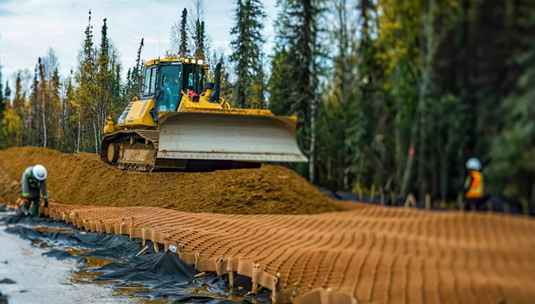
Tough Cell® is a three-dimensional cellular confinement structure that stabilizes and reinforces the aggregate layer, increasing its load-bearing capacity and reducing the thickness of aggregate required to achieve design performance.
Depending on site conditions, this can substantially reduce the volume of imported material needed during construction.
In many applications, Tough Cell® also allows the use of lower-quality local granular materials, recycled concrete aggregate, or reclaimed asphalt pavement (RAP), reducing reliance on imported borrow sources.
By reducing both the quantity of aggregate and the distance it must be transported, project owners can realize meaningful savings before construction is even complete.
Technical Paper »
Innovative Solution For Sustainable Road Construction
Meisam Norouzi, Sanat Pokharel, Marc Breault, Derek Breault

2. Accelerate Construction and Reduce Labour Costs
Labour, equipment, and productivity costs can quickly escalate when crews are required to excavate soft soils, import large quantities of aggregate, and perform multiple rounds of compaction.
Because Tough Cell® reduces aggregate requirements and improves the performance of the road structure, construction activities can often be completed with fewer resources and in less time.
Less material means fewer truck deliveries, reduced placement effort, and less overall handling, which can significantly simplify project logistics in many difficult-to-access locations.

3. Lower Long-Term Maintenance Costs
The true cost of a road extends far beyond initial construction.
Road networks require ongoing grading, resurfacing, aggregate replacement, and repairs throughout their service life. Poor subgrade conditions often lead to rutting, settlement, and frost-related damage that increase maintenance demands year after year.
Tough Cell® distributes loads over a wider area of the subgrade, which reduces stresses on weak soils, helping to maintain surface integrity and improve long-term performance that requires less intervention over time.
Technical Paper »
High Modulus Geocells for Sustainable Highway Infrastructure
Kief, O., Schary, Y., Pokharel, S.K.

Why Engineers Specify Tough Cell®
Beyond construction savings, engineers often specify Tough Cell® because it can be customized to site-specific geotechnical conditions, accommodate a variety of infill materials, and deliver predictable performance across a wide range of infrastructure applications. From temporary access roads to permanent transportation infrastructure, the system provides flexibility without compromising performance.
Proven Across Western Canada’s Most Challenging Conditions
Paradox has successfully supported Tough Cell® projects across a variety of industries, including:
- Oil & Gas
- Mining
- Forestry
- Municipal Infrastructure
- Transportation
- Rail
- Industrial Development
The following projects highlight how Tough Cell® has been used across Western Canada to solve challenging ground conditions while supporting efficient infrastructure development.
Featured Case Studies

Blainville Pad Construction
Ground Reinforcement for Compressor Station

MD Greenview Road Repair
Heavy Haul Road Rehabilitation